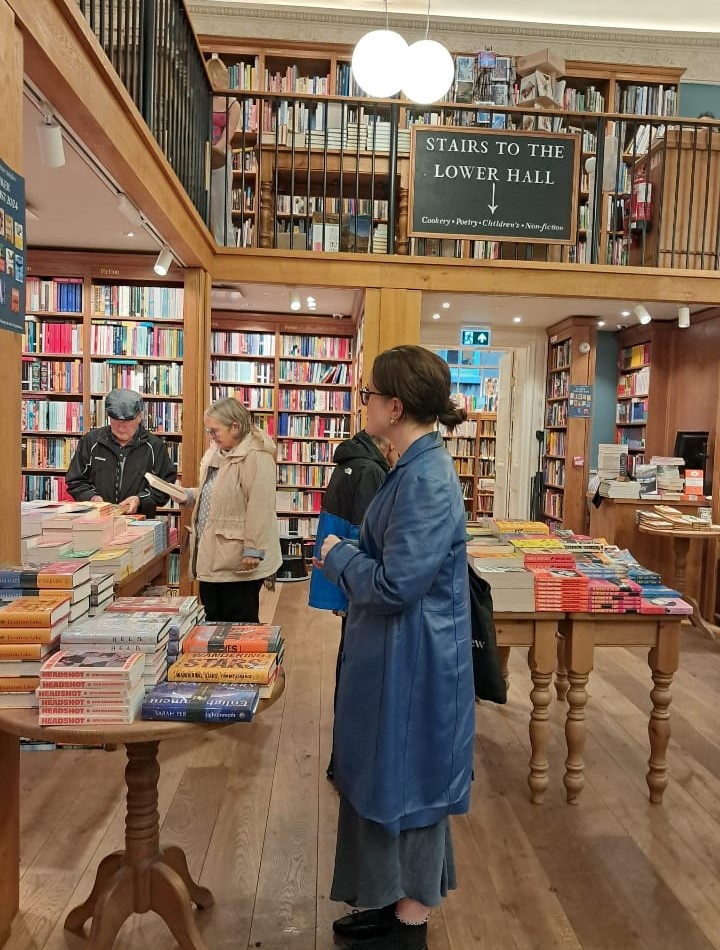
Toppings Bookshop in Bath, 2024
My Research
I am interested in how we mentally endure when the promises of another era – upward mobility and security in return for work, merit, and educational attainment – fail to materialise.
A raft of recent fiction is animated by the sense that the historical present is characterised by a broken link between doing everything “right” and reaping societal rewards. The realisation that working and studying hard no longer guarantee security and affluence registers, in this fiction, as a kind of depressive bathos. There is a feeling – conveyed by the flat affect of much contemporary fiction – that knowledge, information, and understanding are no longer portents of power, and that, on the contrary, depression, anxiety, and apathy are affectively rational responses to the conditions of twenty-first-century capitalism.
My research examines literary fiction’s treatment of mental malaise and political apathy on the one hand, and education and its institutions (such as the university) on the other. I am particularly interested in how fiction treats the relationship between the two. My contention is that hyper-educated mental malaise is a central emerging affect in contemporary fiction and culture. This is important because it means that our understanding of higher education – as a pathway to meritocracy and greater societies of the future – is flawed, and that what Lauren Berlant calls “impasse” has come to dominate the ways in which the most educated and privileged among us think about the political and the social more generally.
My Background
Following a state-school education in Balbriggan, North County Dublin, I started studying English literature, with a minor in History, at Trinity College Dublin as an undergraduate in 2014. In 2016, in my second year, I sat a set of examinations particular to Trinity known as “Schols”. I was successful, and was one of three Two-Subject Moderatorship (TSM) students to be awarded a scholarship that year, as well as one of only fifty to be awarded a scholarship across all disciplines. This covered my fees for the remainder of my education and allowed me to live on campus for my final two years. It also boosted my confidence. I graduated with First Class Honours in 2018, and moved to Edinburgh to complete my Master’s in “Literature and Modernity: 1900 – Present”. It was at Edinburgh that I began to gravitate towards contemporary fiction and critical theory; I also spent the summer working for the Edinburgh Book Festival, which was great craic. I graduated in 2019 with Distinction, and with an offer to return to Trinity to undertake a PhD.
I was lucky enough to be awarded internal funding from the School of English which, combined with my TCD Scholarship, allowed me to begin immediately after leaving Edinburgh. I then entered an application for Irish Research Council funding, and got it. Given the cost of living in Dublin, my PhD would not have been possible without this funding. One of the best experiences of my doctorate was my Early Career Researcher Fellowship at Trinity Long Room Hub Arts & Humanities Institute, from 2020-2023. I have reflected a bit on that experience here.
I passed my Viva in December 2023, and moved to Germany in January 2024 to begin a postdoc at the International Graduate Centre for the Study of Culture (GCSC) at Justus-Liebig Universität, Gießen. While in Germany, I also did some teaching in the Anglistik department at Goethe University of Frankfurt. I then returned to Dublin in September 2024 to begin an Irish Research Council postdoctoral fellowship at UCD.
At all stages of my academic career so far, I have been incredibly lucky to have had some wonderful mentors including, but not limited to: Paul Delaney, Eve Patten, Christopher Morash, Paul Crosthwaite, Ansgar Nünning, and Áine Mahon.

